Using mac-worker
Start with the quick start to install the CLI and connect one Mac. This reference covers agents, task settings, review, batches, capacity, origin delivery, the dashboard, and remote commands. Laptop skills live in the repository at .claude/skills/; they are a local-agent install, not a worker install.
Agents
| Agent | Flag | Login lives | Notes |
|---|---|---|---|
| Codex | --agent codex | file-based login on the worker | --model / --effort are passed through; runs in the Codex workspace sandbox |
| OpenCode | --agent opencode | OpenCode auth store on the worker | uses the worker's default model; pick another with --model opencode-go/<model> |
| Cursor | --agent cursor --env-profile agents | Cursor login on the worker + an env profile | needs the profile described below because Cursor keeps its login in the macOS keychain |
| Claude Code | --agent claude | worker login or env profile | check with worker init <ssh> --agent claude; add --env-profile for profile credentials |
Honor the agent, model, and profile you configured. Do not copy credential profile contents. Every agent gets the same contract: work only in the task worktree, do not switch branches or push, and end with a JSON result. Agents that cannot ask questions interactively return needs_input with the exact question; you answer with worker task say <id> --message "…" --wait, which starts the next turn in the same agent session.
Env profiles
Some agents need environment variables or a keychain unlock on the worker. Put them in an owner-only file on each worker, never in the repository:
umask 077
mkdir -p ~/.config/mac-worker/env && chmod 700 ~/.config/mac-worker/env
$EDITOR ~/.config/mac-worker/env/agents.env      # KEY=value per line
chmod 600 ~/.config/mac-worker/env/agents.env
Recognised keys include CURSOR_API_KEY, and the host-only MAC_WORKER_KEYCHAIN_PASSWORD (plus optional MAC_WORKER_KEYCHAIN_PATH), which mac-worker feeds to security unlock-keychain on stdin right before an agent that needs the login keychain runs. The two keychain values are consumed by the helper and never exported to the agent, logged, or shown anywhere. A profile that is group- or world-readable is refused.
A finished turn whose output matches an agent's authentication-failure signature has outcome agent authentication failed. worker workers then renders that agent as unknown (auth failed in a turn at <UTC minute>) until a later turn of the same agent and profile succeeds, 24 hours pass, Codex's ~/.codex/auth.json is newer than the incident, or you run worker workers --refresh --clear-auth-incidents; on the worker, worker host refresh-facts --clear-auth-incidents does the same. The private incident record stores only the agent, profile name (or none), fixed reason auth failed in a turn, and time. It never stores log content.
You own SDKs, language tools, agent logins, and secrets on each Mac. mac-worker does not install toolchains or copy those profiles.
Task lifecycle
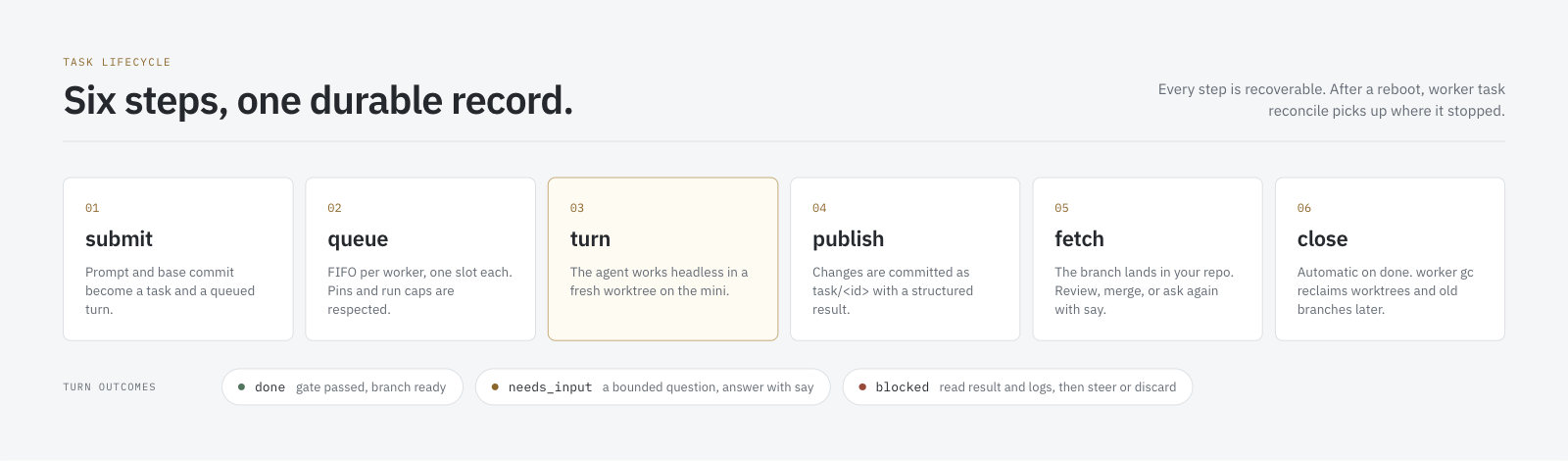
worker task submit   --agent <a> (--prompt TEXT | --prompt-file PATH) [--wait] [--model M] [--effort E] [--close-on done|never]
worker task batch    FILE [--name NAME] [--max-parallel N] [--wait | --preview]
worker task list     [--run ID|NAME] [--state open] [--outcome needs-input]
worker task status   <id> [--full]     worker task logs <id> [-f]     worker task diff <id> --stat
worker task wait     --task-id <id> | --run <ID|NAME> [--timeout 30m]
worker task say      <id> (--message TEXT | --message-file PATH) [--wait]
worker task result   <id>          worker task fetch <id>
worker task cancel   <id>          worker task close <id> [--discard]
worker task reconcile              # re-own dead runners, re-queue orphaned turns; may launch already-frozen eligible DAG children
worker gc [--apply]                # preview, then reclaim old tasks, branches, mirrors on the workers
Confirm the installed grammar with worker task --help. There is no worker task accept verb.
worker task batch FILE --preview validates the file and prints the plan (dag.status = "enforced"). It does not open client state or dispatch. --preview conflicts with --wait. Submit of a named graph (depends_on or base = "from:<id>") freezes that run and launches eligible roots; invalid or cyclic graphs are TASK_CONFIG_INVALID and create no run. Independent batches (empty depends_on and no from:) keep today's create-run-and-submit path.
--max-parallel is a requested run cap. Omitted, it defaults to sum(worker.slots) on the machine that owns the queue (each worker defaults to 1). An explicit positive value is accepted even when it is larger than that sum or than current host occupancy; extra tasks wait for a free execution slot. Zero is TASK_CONFIG_INVALID. The CLI does not reject “too many” relative to host capacity. On a controller-only laptop config, omit the flag rather than resolving it from an empty [[workers]] list; see Remote controller.
worker task logs without --raw prints recognised agent events one line at a time, hides per-token noise, and folds consecutive unrecognised structured events into event: <type>[/<subtype>] ×N summaries (the count is omitted for one event). It keeps stderr and launch failures verbatim and prints failure lines such as turn 1 failed: … even when the agent wrote nothing; use --raw for the original log bytes.
worker task wait returns only when all selected tasks are quiescent and their runners have released ownership, so worker task close, worker task say, and worker task fetch can run immediately afterward. wait --run is not complete while DAG nodes are still waiting or claimed; an empty materialized task list is not completion. After runner recovery, worker task reconcile also advances already-frozen eligible DAG nodes; it does not start a new operator batch. Capacity errors such as CAPACITY_BUSY and CAPABILITY_MISSING retain their public reason and exit code 75 through the controller.
worker task reconcile adopts, restarts, or finalizes a row only on positive proof that the previous runner exited: the pid was reused by a different process, or Absent was seen twice at least 750 ms apart. A single missed lookup, an ambiguous process-table read, or a transient error is unverifiable — the row is left alone, the report counts it, and task list shows RUNNER_UNVERIFIABLE only after that state has lasted 30 s. The operator path uses the same rule; it does not treat unverifiable as exited.
Outcomes are recorded on the task, independent of the process exit code:
done: the agent finished and the branch is published. That is not human acceptance. Default--close-on donethen closes the task. Origindeliverymay still bepending/retrying. For a human review loop (ready for review → follow-up → accepted), submit with--close-on never, thenworker task sayas needed andworker task closewhen you accept.needs_input: the agent has a bounded question;sayanswers it.blocked: the agent could not finish. Readresultandlogs, thensayguidance orclose --discard.unknown: the agent did not return a structured result; the branch is still published.
If a worker job or its logs vanish after acceptance, the task outcome is failed: LOG_DRAIN_UNAVAILABLE. worker task wait --task-id <id> completes with exit 1, worker task logs -f <id> stops, and the dashboard shows the same outcome. A later worker task say <id> --message "…" starts a fresh turn. The result may still have been imported before the failure was finalized: inspect worker task result <id> and use worker task fetch <id> to check or import it.
When a replacement runner exits, its journal line distinguishes whether the worker accepted the turn. exited: <code> … is the pre-acceptance form: the worker did not accept that turn, so worker task reconcile can retry the handoff. exited after acceptance: <code> … means the journal already records acceptance; worker task reconcile resumes that turn from its committed offsets instead of submitting it again. After the post-acceptance form, inspect the worker with worker workers --refresh, especially if the job or its logs may have disappeared. Both lines are passed through worker task logs verbatim.
worker task result / status --json show the outcome, summary, and any agent-reported checks (reported_checks on protocol 7). Those checks are claims from the worker agent, not independent verification. worker task diff <id> --stat lists the published change. worker task fetch <id> prints the remote-tracking ref (refs/remotes/mac-worker/<worker>/task/<id>) — the current-turn import proof on the laptop. Your working tree stays unchanged.
Review and close
Default --close-on done auto-closes after agent done. For an explicit review loop:
worker task submit --close-on never --agent <a> --prompt-file brief.md
worker task wait --task-id <id>
worker task result <id>
worker task diff <id> --stat
worker task fetch <id>
worker task close <id>            # human accept
# or: worker task say <id> --message-file followup.md --wait
# or: worker task close <id> --discard
Public CLI say / close have no revision flags. Wait first. Dashboard reply/accept are the same operations with a current-card check (Dashboard).
Project setup
Optional [setup] in .worker.toml is opt-in. Absent, behavior is unchanged. Commands are operator-written; mac-worker never infers packages.
[setup]
timeout = "10m"
commands = ["cargo fetch --locked"]
check = "cargo fetch --locked --offline"
lockfiles = ["Cargo.lock"]
check proves this workspace only. A matching identity in another worktree is not readiness. You own the toolchain. Profile names may appear in identity hashes; profile values and secrets do not.
Capacity and slots
Each [[workers]] entry defaults to slots = 1 per worker (1..=8). That laptop value is a client ceiling. The Mac’s durable authority is leases/capacity.json { "slot_count": N } on the host (hidden worker host set-slots N). Combined detached runner capacity is sum(worker.slots), not the number of workers.
Same task_id is serialized (WORKSPACE_BUSY). Distinct task IDs from one checkout may overlap when that host’s slot_count >= 2. Layout, migrate, and probe occupancy: multiple execution slots. Extra slots do not make Git/object transfers independent: a worker still serializes a job behind its transfer lock. On a controller, slow object verification and pinning can delay unrelated transfer preparation and finalization. The streaming pack child does not hold the global transfer lock for its lifetime.
worker task submit waits for capacity by default. Omitting --wait lets the CLI return after admission; it does not disable queueing. Add --no-wait to reject a submit when eligible workers are at capacity (CAPACITY_BUSY, exit 75). In controller mode an admission rejection with CAPACITY_BUSY or CAPABILITY_MISSING is saved as a final result: it keeps the public reason and cannot become a delayed task when capacity changes. To try again, submit a new request. Transport failures follow the controller's recovery path and are not capacity rejections.
Origin delivery
With publish = push, each turn pins a durable delivery intent before the execution slot is released. Agent outcome and origin state are independent: done plus origin pending is valid. status / dashboard project remote delivery without rewriting a Closed local record. Discard while delivery is pending/retrying is TASK_BUSY (DELIVERY_PENDING).
Host pump (hidden worker host, not in top-level --help):
| Flag | Semantics |
|---|---|
--watch | Take outbox.lock or exit immediately if another pump holds it. Publish watcher identity, recover the due registry once, then loop. Between pump cycles (at most every ~10 s) the watcher stats its own executable; if the file on disk no longer matches, it logs outbox watcher exiting: binary replaced and returns so a KeepAlive LaunchAgent restarts the current binary. |
--once | Blocking one-shot pump. If the pump lock is held, OUTBOX_BUSY. Does not spawn --watch. |
--enable | Write locks/outbox-enabled.json. Does not start a watcher. Reboot recovery is --enable plus a LaunchAgent that actually starts --watch. |
--wake | Hidden. If a live watcher is already this binary, no-op (woken). If it is a replaced image, SIGTERM it, wait up to 15 s for the pump lock, and start --watch (restarted). If locks/outbox-enabled.json is absent the setup path prints not_enabled and does not treat that as an error. |
KeepAlive recipe (no launchctl from the helper itself):
worker host outbox --enable
worker host outbox --write-agent ~/Library/LaunchAgents
launchctl bootstrap gui/$(id -u) ~/Library/LaunchAgents/com.mac-worker.outbox.plist
--write-agent writes a KeepAlive plist whose ProgramArguments pass --host-root and whose stdout/stderr go to <host_root>/logs/outbox.log. After worker setup the worker helper wakes that watcher; the self-check plus KeepAlive keep it on the binary just installed. Setup prints the per-worker outcome under the installed line (outbox: woken, restarted, not_enabled, or failed OUTBOX_WAKE_FAILED); a wake failure is a worker warning, not a failed install.
mini-1: installed (protocol 7)
  outbox: restarted
Pick one owner for the watcher on a worker. Without a LaunchAgent, worker setup (through --wake) starts a detached watcher and replaces it after every reinstall; a reboot needs one worker setup or host outbox --wake to bring it back. With a LaunchAgent loaded, the self-check plus KeepAlive already restart the watcher on the new binary, and a detached watcher started by --wake would hold the pump lock while launchd keeps relaunching its own instance every throttle interval; do not combine the two until --wake is launchd-aware.
--once is a one-shot pump, not a substitute for --watch. Do not treat a single --once after a crash as proof that due-registry recovery already ran; --watch recovers the due index on start. Host layout of intents, pins, and the due registry: durable origin outbox.
After a delivery reaches terminal failed (12 attempts, typically while origin credentials were broken), the watcher ignores it. Repair the worker login, then worker task publish-retry <task_id> resets that task's failed or retrying intents to retrying with attempt 0, records retry_requested_at_millis, and wakes the pump. The host's returned deliveries are merged into the laptop task record, so worker task status/result/list show them even when the task is already Closed and is no longer re-observed from the worker. If a concurrent local write wins the record after the host accepted the retry, the command still succeeds and prints a warning. Delivered or superseded intents are refused (DELIVERY_ALREADY_DELIVERED). An older helper that does not know host outbox-retry returns HOST_COMMAND_UNSUPPORTED. The task itself can already be Closed; this command does not reopen it.
Project defaults:
[task]
default_agent = "codex"
source = "local"            # or "origin": start from the exact commit on your Git remote
publish = ["fetch"]         # add "push" to also push task/<id> to origin
timeout = "45m"
max_followups = 10
.worker.toml [task] has no close_on field. Set close policy with --close-on on submit, or close_on at the batch top level or on a [[tasks]] entry (done or never).
To use the exact base commit from your Git remote and push the result branch back to that remote:
[task]
source = "origin"
publish = ["fetch", "push"]
The base commit must already be on the remote. The worker account needs its own Git access to that remote; SSH agent forwarding from the laptop is disabled. --wip cannot push (PUBLISH_REQUIRES_COMMITTED_BASE).
Origin URL and worker credentials
The origin URL is the project's origin remote. mac-worker does not take a separate origin URL.
Declare the host on each worker that should fetch from or push to that remote:
[[workers]]
name = "mini-1"
ssh = "yourname@mini.local"
slots = 1
capabilities = ["darwin-arm64", "origin:github.com"]
source = origin and publish = push require origin:<host> where <host> matches the remote (github.com, gitlab.example.com). A pinned worker without it fails with CAPABILITY_MISSING. See Prepare a Mac worker for the worker-side Git login.
Git on the worker stays hermetic during origin operations (the account ~/.gitconfig is not loaded into the push). For HTTPS origins the worker account needs a credential helper: gh auth login then gh auth setup-git on the worker. For SSH origins the worker's own key must be registered with the remote.
worker workers prints origin:github.com: helper configured or helper missing. worker doctor warns ORIGIN_HELPER_MISSING when a declared origin has no HTTPS helper. A push git rejects as unauthenticated is ORIGIN_AUTH_FAILED (not the generic PUBLISH_FAILED) and keeps retrying with the existing backoff.
A batch file groups tasks into a run with shared defaults. Independent tasks (no depends_on, no base = "from:<id>") still submit together:
version = 1
agent = "codex"
timeout = "45m"

[[tasks]]
title = "Flaky login spec"
prompt_file = "tasks/fix-flaky-login.md"

[[tasks]]
title = "Extract billing client"
prompt = "Move the billing HTTP client into packages/billing-client …"
agent = "opencode"
Named dependencies execute when each parent is Closed and Done (including close_on = never, which needs human close after a Done turn). Open+NeedsInput and Open+Done wait. Failed, Abandoned, Lost, or Closed without Done block descendants (DAG_PARENT_FAILED); they are not launched. from: copies that parent's current accepted imported OID on the laptop; origin pending does not block the bind when the local import proof is complete. Submit freezes each node's prompt, settings, and base OID; restart does not reread the batch file. List rows for not-yet-submitted nodes may show DAG_WAITING or DAG_CLAIMED.
version = 1
agent = "codex"
timeout = "45m"

[[tasks]]
id = "api"
prompt_file = "tasks/api-validation.md"
close_on = "never"

[[tasks]]
id = "tests"
depends_on = ["api"]
base = "from:api"
prompt_file = "tasks/api-tests.md"
Preview with worker task batch tasks.toml --preview before dispatch. Lifecycle: batch DAG.
[task]
default_agent = "codex"
model = "gpt-5.6-luna"
effort = "max"
env_profile = "agents"
source = "local"            # or "origin": start from the exact commit on your Git remote
publish = ["fetch"]         # add "push" to also push task/<id> to origin
timeout = "45m"
max_followups = 10

[setup]
commands = ["cargo fetch --locked"]
check = "cargo fetch --locked --offline"   # current workspace only
lockfiles = ["Cargo.lock"]
Optional [setup] runs in the task workspace with the same account and env-profile as the agent, before the agent starts. Absent [setup] keeps today's defaults. check proves this workspace is ready; a matching identity in another worktree is not skip proof. Toolchains stay user-owned.
worker task batch FILE --preview resolves agent/model/worker, declared files, acceptance, and setup without creating tasks, opening client state, or talking to workers. Preview reports dag.status = "enforced" (Dependencies execute when parents are Closed and Done.). Submit of depends_on or base = "from:<id>" executes that graph; independent batches stay on today's path. Declared files are advisory overlap hints. Declared acceptance is copied into the agent prompt as instructions, not proven by mac-worker.
To use the exact base commit from your Git remote and push the result branch back to that remote, change these project settings:
[task]
source = "origin"
publish = ["fetch", "push"]
The base commit must already be on the remote. The worker account needs its own Git access to that remote; SSH agent forwarding from the laptop is disabled.
Writing good briefs is its own skill. Two Claude Code skills ship with the repository and work from any project: pool-task-authoring turns an objective into one-turn, headless-safe tasks, and pool-dispatch is the mechanical submit / wait / answer / fetch loop. Say "send it to the pool" and Claude Code uses them.
When a turn fails
A turn can fail instead of returning done, needs_input, or blocked. The outcome or error code is a fixed public string. Start with the command listed for that string.
agent exited N: readworker task logs <id>.agent authentication failed: re-login on the worker, then runworker workers --refresh --clear-auth-incidents.LOG_DRAIN_UNAVAILABLE: checkworker task result <id>; the worker's job is gone and remaining stdout/stderr cannot be drained.CAPACITY_BUSYon a pinned submit: wait, or choose another worker.TASK_BUSYon close: wait forworker task waitto return, then retry.ORIGIN_AUTH_FAILED: the worker could not authenticate to origin. Checkworker workersforhelper missing, then on the worker rungh auth loginandgh auth setup-git(HTTPS) or register the worker's SSH key. Delivery keeps retrying until 12 attempts; afterfailed, runworker task publish-retry <task_id>instead of resubmitting the task.
worker task wait is also the gate before say and fetch after a busy turn.
A host I/O failure may include HOST_IO (stage=…, residual=…) on that job. stage is one of admission, prepare, launch, drain, publish, cleanup, lease-release, cancel, follow. residual lists leftovers of this job only (lease, cleanup-tree, job-dir, supervisor-lock, transfer-lock, session, workspace). Observation errors omit a residual rather than guessing it is still there. This is diagnostic text on the existing HOST_IO string, not a new CLI verb.
Dashboard
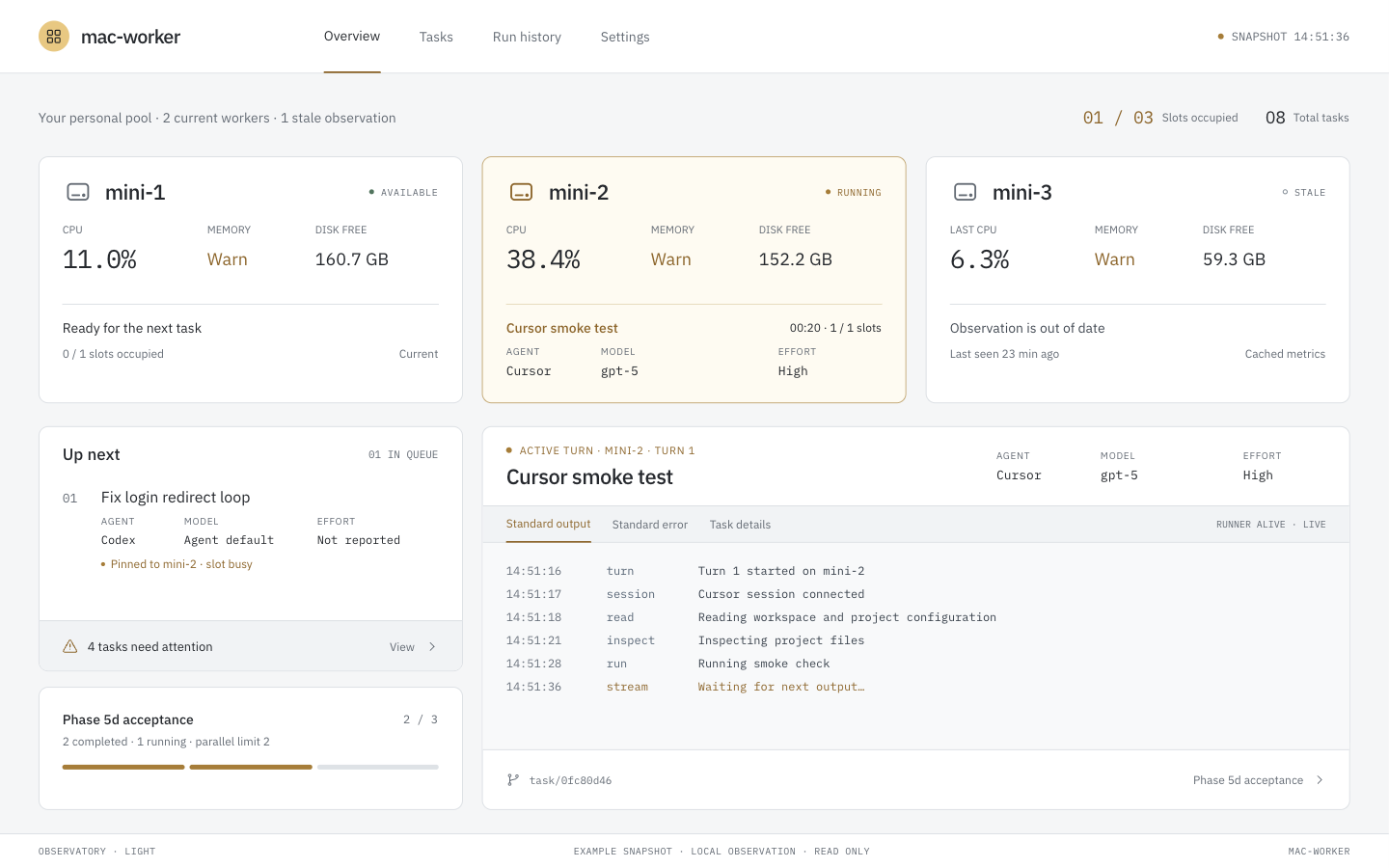
worker dashboard                 # opens http://127.0.0.1:<port>
worker dashboard --port 8765 --no-open
worker dashboard --no-facts-refresh   # skip stale agent-facts refresh only
The dashboard listens only on loopback. It does not start or cancel tasks. In the default (controller-disabled) mode it serves the laptop queue. When [controller] enabled = true, the same command does not open laptop task state: it starts a managed SSH local-forward to the controller host’s loopback dashboard, waits until that URL answers, prints http://127.0.0.1:<port>, and holds the tunnel until you stop the command. --port, --no-open, and --no-facts-refresh still apply. Tunnel or transport failure is CONTROLLER_UNAVAILABLE with no laptop-store fallback.
It shows workers (including slot occupancy and host load), the FIFO queue, active turns, the task ledger, per-task detail (outcome, summary, agent-reported checks, changed files, fetch ref, delivery), and run history. Deep link #/tasks/<id> selects that card. It never shows prompts, credentials, or profile values.
--no-facts-refresh disables the optional fifteen-minute agent-facts refresh so Overview does not probe idle workers. It is not a read-only switch: Settings can still save native model/effort defaults, and task cards can still reply or accept.
Reply and accept use the same TaskClient::say / close paths as the CLI. They require the current card. A stale card is rejected (TASK_REVISION_CONFLICT, HTTP 409) and must not enqueue another turn.
POST /api/v1/tasks/{task_id}/reply
POST /api/v1/tasks/{task_id}/accept
Loopback Host / matching Origin, Content-Type: application/json, X-Mac-Worker-Task: 1, body ≤ 8192 bytes. JSON:
{
  "message": "optional for reply",
  "expected_task_id": "<canonical>",
  "expected_turn_id": "<last turn>",
  "expected_turn_count": 1,
  "expected_head_oid": "<40 hex or null>",
  "expected_updated_at_millis": 123,
  "expected_state": "open"
}
Public CLI say / close do not take these fields. Snapshot GET JSON remains at GET /api/v1/snapshot, GET /api/v1/tasks/<id>, and GET /api/v1/tasks/<id>/turns/<turn>/logs.
The interface is a React application in ui/, built with Tailwind and shadcn/ui and embedded into the binary at build time, so cargo build needs no JavaScript toolchain.
Herdr
If you run herdr on the workers and on your laptop, the pool can show its turns there.
- Sidebar rows on the worker's herdr. A worker with
herdr = trueinconfig.tomlopens amac-workerworkspace in its own herdr and one tab per running turn, labelledtask <id> · turn <n>.worker task closeremoves the task tab; when it was the last task tab and no operator tab remains, the reporter removes the workspace too. The row carries the task title, the agent's icon, and the turn's state:workingwhile the agent runs,blockedwhen it needs input,donewhen it finished,unknownwith the reason when it failed, was cancelled, timed out, or was lost. Herdr 0.9's machine link and the herdr-mirror plugin both bring those rows to your laptop next to your local agents. A follow-up turn replaces the tab. - A readable log in the pane. The tab's pane runs
worker host follow-turn, a read-only command that renders the turn's event stream the wayworker task logs -fdoes and prints the outcome line when the turn ends. You cannot type to the agent there: the turn stays headless. - Notifications on the laptop. With
[notifications] herdr = true(the default) the turn runner tells the herdr you started the command in that a turn ended:task <id>: donewith thedonesound,needs_inputandblockedwith therequestsound. Without a reachable herdr socket nothing happens. - Where to check.
worker workersandworker doctorprint aherdr:line per worker (available (0.9.0),not installed,installed, no socket,installed, no response, orunknownwhen facts are missing); a known fact older than the TTL is printed with astalesuffix (available (0.9.0), stale 69m) rather thanunknown;doctorandsetupwarn withHERDR_UNAVAILABLEwhen a worker hasherdr = truebut its herdr cannot be reached. Turns still run without the reporter, andworker task status --jsonrecordsherdr: attached,unavailable, or nothing for each turn. - Dashboard chip and scheduling. When the count is known and non-zero, the
herdr:line fromworker workersorworker doctorends with, N interactive agents. The worker card and capabilities view show the same herdr fact in a chip (herdr 0.9.0,herdr 0.9.0 · 2 agents,no herdr,herdr: no socket, …), not counting mac-worker's own reporter tabs. Scheduling uses the count only as a last tie-breaker among otherwise equal workers; it never excludes a worker.
Sidebar tokens task, turn, mw_title, mw_agent, and mw_outcome are published with every row for custom herdr row layouts. The design and its budgets are in the herdr reporter design.
Configuration
~/.config/mac-worker/config.toml is written by worker init and holds one [[workers]] block per Mac in the default laptop-owned mode. A controller-only laptop config may omit [[workers]] (see Remote controller). Two optional keys concern herdr, the terminal workspace manager the pool can report into:
[notifications]
herdr = true      # default true: notify this laptop's herdr when a turn ends; silent without a socket

[[workers]]
name = "mini-1"
ssh = "yourname@mini.local"
slots = 1         # per-worker client ceiling; default 1, max 8; combined cap is the sum
herdr = false     # default false: show this worker's turns in its own herdr sidebar
The design behind both keys is in the herdr reporter design.
Optional remote controller (off unless you set it; see Remote controller):
[controller]
enabled = false
# ssh = "yourname@always-on-host"
# remote_binary = "~/.local/bin/worker"   # only this path is accepted
Remote controller
Opt-in. Default remains the laptop-owned queue: omit [controller], or keep enabled = false. Confirm flags with worker controller --help and worker dashboard --help. Do not treat a missing table as a second store.
Use this when an always-on Mac should keep the queue after the laptop sleeps or disconnects. The laptop still freezes the prompt and Git objects. Execution workers stay ordinary host helpers. There is one task store — on the controller host — not a laptop copy that silently takes over.
Enable
On the laptop config.toml:
[controller]
enabled = true
ssh = "yourname@always-on-host"
remote_binary = "~/.local/bin/worker"
ssh must be a valid destination (same family as a worker entry). remote_binary must be exactly ~/.local/bin/worker. When this mode is on, a real SSH or host controller-rpc failure is CONTROLLER_UNAVAILABLE — not a silent return to a laptop task queue. Absence of worker controller run is not that outage.
On the controller host, install the same CLI, put that host’s execution workers in its config.toml, and run:
worker controller runThat process takes the leader lock, resumes unfinished requests and bounded active tasks, prints controller leader acquired, and stays in the foreground until you stop it. Keep it running for autonomous progress (recovery, DAG readiness, turn runners). Laptop task commands use a separate host controller-rpc over SSH; that helper can accept and persist a queued submit even when the leader is not up. Do not treat a missing leader as a transport failure, and do not assume every RPC requires a live controller run. A second live controller run on the same host is CONTROLLER_LOCK_HELD. Restart is stop, then worker controller run again — it resumes the same store. This is not launchd and is not started from the MacBook as a local daemon.
The controller host owns the worker list used for dispatch. A laptop config with [controller] enabled = true may omit [[workers]]. Laptop commands that then fail with at least one worker is required are worker setup, worker doctor, worker workers, worker run, streaming worker logs, and worker gc. Public job status and cancel stay laptop-local and do not use that inventory error. That is explicit, not empty-pool scheduling.
These stay on the laptop even when the controller is enabled: init, setup, doctor, workers, gc, run, job status/logs/cancel, and worker task batch FILE --preview. Turn runners run on the controller host, not on the MacBook.
Submit, disconnect, reconnect
Task commands use the same public grammar as today (worker task --help): submit, batch, list, status, logs (-f / --raw / --turn), diff, say, cancel, result, fetch, close, wait, reconcile. Confirm the installed form with worker skills get pool-dispatch --grammar-only rather than copying flags from a skill file.
On submit the laptop freezes the prompt, project identity, settings, and base (HEAD, --base, or --wip / --include) and transfers that snapshot before the controller accepts the request. A retry of the same original envelope keeps that freeze; it does not recapture a later HEAD or .worker.toml. After accept you can close the laptop CLI. That ACK means the request is persisted on the controller store; it does not mean a runner or the agent has started — enabled submit can stay queued until worker controller run advances it. Reconnect with status, logs, wait, list, and the dashboard.
Without --wait, submit / batch / say return after that accept. Autonomous progress on the controller still needs worker controller run. With --wait, the same command follows until the selected task or run is quiescent. worker task wait --task-id waits for one task; worker task wait --run waits until that run is quiescent, including DAG children that become eligible after a parent close.
--wip is still opt-in local snapshot with fetch-only publication. Origin source still needs the exact remote commit. publish = push still cannot use a WIP base (PUBLISH_REQUIRES_COMMITTED_BASE).
Import is not fetch
The controller imports the worker’s published result so later DAG work can proceed while the laptop is away. That import is not your working copy. worker task fetch <id> is the explicit laptop materialization: it prints the remote-tracking ref for you to inspect. A missing laptop branch is not an agent failure.
Batches and slots
worker task batch FILE --preview stays local: it validates the file and does not open the controller store or dispatch. It works with a controller-only laptop configuration, including worker pins. The preview preserves those names; the controller checks its own inventory when you submit. A successful preview does not prove that a worker exists or is currently available.
Named depends_on / base = "from:<id>" still wait for each parent to be Closed and Done (including close_on = never, which needs human close before a from: child may run). Open+NeedsInput and Open+Done wait. Failed, Abandoned, Lost, or Closed without Done block descendants (DAG_PARENT_FAILED). from: binds that parent’s accepted controller import, not origin pending and not a laptop fetch you have not run.
--max-parallel remains CLI-only (not a batch-file key). Omitted, the default is the controller host sum(worker.slots), not an empty laptop [[workers]] list. An explicit positive value is accepted even when it is larger than that sum; extra tasks wait. Zero is TASK_CONFIG_INVALID. The CLI does not reject “too many” relative to host capacity. Host occupancy is still each Mac’s slot_count.
Controller Git object transfer uses one global lock for object verification and pinning. A slow repository can delay unrelated transfer preparation and finalization. Extra slots do not make those steps independent. The streaming pack child does not hold that lock for its lifetime.
Dashboard
worker dashboard [--port N] [--no-open] [--no-facts-refresh] on an enabled laptop is the tunnel described in Dashboard. Reply and accept still require the current card against the store the dashboard is serving.
Protocol 7 stays the version: a host may add fields to facts and probe JSON; a laptop must not reject them. The host still rejects unknown keys in its own facts.json and in requests it validates. After updating the CLI, restart a running dashboard or worker controller run — already-running processes keep the old code after a binary replacement. A still-running dashboard that started this build compares the file it launched from with the installed binary and sets additive laptop.binary_outdated = true so the UI can show worker was updated, restart the dashboard. worker setup and worker doctor warn when they find those processes via the process table. See Update or remove.
Close request recovery
A saved task.close request whose target has changed is rejected before any close action with TASK_REVISION_CONFLICT or TASK_CLOSED. The controller saves that rejection and removes the request from the active retry index. Replaying the same request returns the saved rejection; it does not close a newer turn. Existing stale requests are settled when the updated controller next processes them, including through its recovery tick. Their journal records remain available for diagnosis.
Errors from an already-started close, including transport failures after retaining the close intent, remain retryable. A repeated close of the same completed target is still idempotent. Wait for worker task wait --task-id <id> before closing an active task.
What the pool will and will not do
- A task worktree is isolation for your repository, not a security boundary: agent turns run with the worker account's full access. Only dispatch prompts you trust, on machines you own.
- Your working tree is never modified. Results arrive as remote-tracking refs; merging is your decision.
- You own SDKs, tools, auth, and secrets. Optional
[setup]does not install arbitrary packages. - Agent-reported checks are not independent verification. Review summary, diff, and fetch ref before you accept.
- Workers hold a bare mirror per project, a worktree per task, agent sessions, and bounded logs.
worker gcpreviews and reclaims them: idle open tasks after 7 days, result branches after 30 days or onclose --discard. - The CLI adds no secrets to its own diagnostics, redacts worker paths from agent summaries, and refuses insecure profiles. Application logs can still contain whatever the agent printed.
worker task reconcilerepairs task ownership after a laptop reboot (or on the controller host when enabled). It waits 750 ms to confirm anAbsentowner in that same invocation; a still-unverifiable owner is not treated as dead.worker setupupdates helpers; older host layouts may require the steps in installation recovery.- The laptop owns the queue unless you opt in to a remote controller (
[controller] enabled = true). That mode is off by default. Setup: Remote controller.
Plain remote commands
The task system is built on a simpler layer that is still available: run any trusted, non-interactive command on a worker from a snapshot of the current worktree.
worker run -- cargo test --locked           # scheduler picks a worker
worker run --worker mini-2 -- npm test      # pin one
worker status                               # recent jobs
worker logs -f <job-id>
worker cancel <job-id>
worker doctor --project .                   # validate a project before its first job